PPA vs. PA6 Glass-Fiber Reinforced: Thermo-Mechanical and Rheological Optimization in Precision Gears
23 July 2026


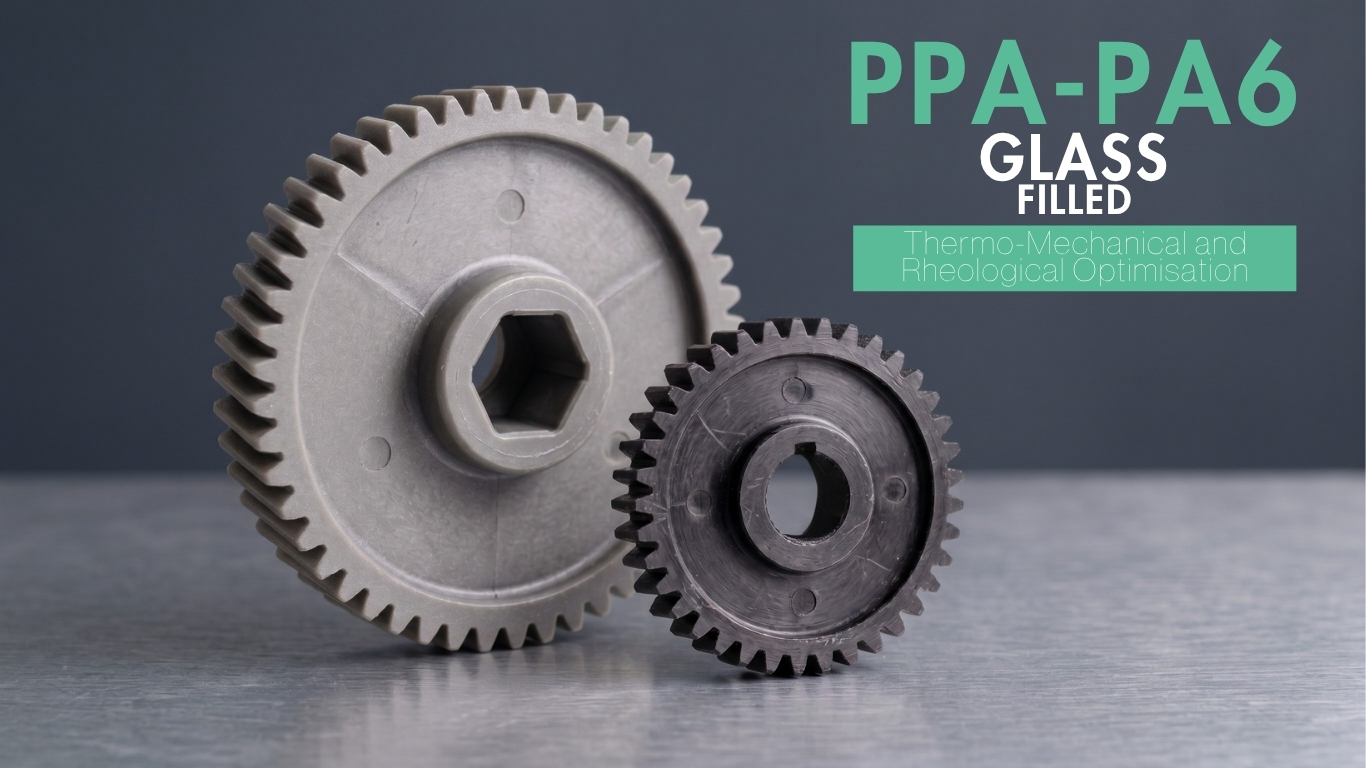
In high-performance power transmission applications — with particular reference to under-the-hood automotive powertrain systems and industrial servomechanisms — kinematic precision is a critical parameter. Such precision is strictly bound to dimensional stability, creep resistance, and the structural stiffness of rotating components.
Replacing metals with engineering polymers ensures a dramatic reduction in rotational inertia (mass reduction up to 70%), acoustic damping, and chemical inertia. However, the design of polymer gears requires rigorous macromolecular and rheological analysis.
At Stagnoli, we daily process both aliphatic polyamides (such as PA6) and high-performance semi-aromatic polyamides (PPA). Both polymer matrices, reinforced with glass fiber, offer extraordinary engineering advantages: the choice depends on the precise thermodynamic and environmental balance required by the application.
Macromolecular Analysis: Thermo-Mechanical Behavior of PA6 and PPA
Both PA6 and PPA belong to the family of semi-crystalline polymers, but their molecular architecture dictates distinct thermo-hygrometric behaviors during operation.
- PA6 (Aliphatic Polyamide): Synthesized via ring-opening polymerization of caprolactam, it features a flexible molecular structure with 6 carbon atoms between amide groups. This conformation confers exceptional impact resistance (intrinsic toughness) and superb surface aesthetics to molded parts, as its slightly slower crystallization kinetics compared to PA66 allow superior glass fiber wetting. However, its strong polarity makes PA6 highly hydrophilic (capable of absorbing up to 9-10% moisture at saturation). Water acts as a plasticizer: it lowers the Glass Transition Temperature (Tg) from the dry-as-molded state (~55 °C) to values below room temperature (down to -10 °C). This hydration increase significantly enhances impact resilience, but induces a physiological variation in Elastic Modulus and a slight volumetric swelling.
- PPA (Polyphthalamide / Semi-Aromatic Polyamide): The introduction of aromatic (benzene) rings into the main backbone restricts molecular mobility and generates significant steric hindrance. Thermodynamically, this drastically elevates the Tg (between 120 °C and 140 °C) and the melting temperature (Tm exceeding 300 °C). Furthermore, the lower density of polar groups makes PPA much more hydrophobic than PA6. The result is a polymer that suffers no significant performance degradation when exposed to moisture and maintains constant flexural stiffness even at elevated operating temperatures.
Quantitative Comparative Analysis: PA6-GF30 vs PPA-GF30
To understand the practical application impact, we analyze comparative data for these two matrices, both reinforced with 30% glass fiber (GF). Indicative values based on standardized ISO 527 (Tensile) and ISO 75 (HDT) tests.
Physical-Mechanical Property | PA6 + 30% GF | PPA + 30% GF | Notable Variation |
Elastic Modulus (E) - Dry State | ~9,000 MPa | ~11,500 MPa | Modest PPA advantage |
Elastic Modulus (E) - Conditioned (50% RH) | ~5,500 MPa | ~11,000 MPa | Clear PPA advantage (immunity to plasticization) |
Tensile Strength (Dry) | ~165 MPa | ~210 MPa | Superior in PPA |
HDT (Heat Deflection at 1.8 MPa) | ~205 °C | ~280 °C | +75 °C thermal stability under load for PPA |
Moisture Absorption (Saturation) | 7.0 - 8.5 % | 1.5 - 2.0 % | Drastic hygroscopicity reduction in PPA |
Continuous Use Temperature (CUT) | ~90 - 110 °C | ~150 - 170 °C | Long-term thermo-oxidative resistance for PPA |
Molding Shrinkage (Longitudinal) | 0.3 - 0.5 % | 0.15 - 0.4 % | Lower post-molding deformability for PPA |
Project Optimization: When to Choose PA6 vs. PPA?
Polymer selection must be based on tooth stress analysis (Lewis/Hertz equations) and the operating environment to optimize Total Cost of Ownership (TCO).
The Domain of PA6-GF30: Where operating temperatures consistently remain below 90 °C and there are no centesimal tolerance requirements under extreme moisture fluctuations, PA6-GF30 remains an absolute industry standard. The plasticizing effect of absorbed moisture, far from being merely a limitation, imparts to the gear an exceptionally high capacity to absorb sudden mechanical shocks (preventing catastrophic tooth shear) and excellent fatigue resistance. Moreover, it offers superb surface aesthetics (reduced fiber blooming) and remarkable ease of molding at lower temperatures (mold at approximately 80 °C), ensuring an extremely competitive piece cost.
The Technological Leap of PPA-GF30: PPA becomes indispensable in two severe application scenarios:
- Dimensional Stability and Center-Distance Tolerances: The absence of hygroscopic swelling enables the molding of precise involute gears that undergo no geometric variations over time. This prevents excessive backlash or, conversely, kinematic jamming induced by environmental humidity.
- High Temperature and Chemical Resistance (Automotive/Industrial): At temperatures above 100 °C in the presence of aggressive fluids (e.g., engine oil or glycol), PA6 is subject to rapid hydrolytic degradation. PPA chemically withstands these agents without alteration of molecular weight and, thanks to its high Tg, prevents flexural deflection of the tooth under continuous load.
Process Constraints (Troubleshooting and Fluid Dynamics)
From a process engineering standpoint, injection molding of glass-reinforced resins imposes severe physical challenges for both matrices:
- Anisotropy and Weld Lines: Under the high shear stress of injection, glass fibers orient parallel to the flow direction. This generates mechanical and shrinkage anisotropy. The most critical zone is the weld line, where melt fronts meet: in this region, fibers cannot cross-link across the interface, reducing local mechanical strength by up to 40-50%. At Stagnoli, we optimize runner channels and gating locations via fluid-dynamic simulations (Moldflow) to position weld lines away from maximum stress areas (such as the tooth root fillet).
- Mold Thermodynamic Management (PPA): Unlike PA6, which crystallizes readily with water-tempered molds (80-90 °C), PPA requires slower and more energy-intensive crystallization kinetics. To prevent parts with an amorphous skin (which would cause disastrous post-shrinkage and geometric distortion in service), PPA strictly requires diathermic oil-tempered molds or electrical heating systems at 140-160 °C.
Frequently Asked Questions (FAQ)
- Is molding shrinkage identical between 30% glass-filled PA6 and PPA?
No, volumetric shrinkage differs. PA6-GF30 exhibits shrinkage heavily influenced by post-hydration: the freshly molded part shrinks, but subsequently tends to expand slightly upon absorbing environmental moisture. PPA-GF30 exhibits lower molding shrinkage and, being hydrophobic, delivers a final, stable geometry immune to post-molding atmospheric variations.
- What precautions are required to prevent mold wear with 30% glass fiber?
Glass fiber is highly abrasive. In our manufacturing facility, to process 30% glass composites (both PA6 and PPA based), we utilize bimetallic plasticizing units highly resistant to erosive wear. Gear molds are machined from alloyed tool steels (e.g., AISI D2 / 1.2379 or powder metallurgy steels) subjected to vacuum hardening and anti-wear surface treatments (such as PVD coatings) to preserve the micrometric tooth profile over time.
- If a PA6-GF30 gear breaks due to impact, does switching to PPA-GF30 solve the problem?
Not necessarily. If failure is caused by thermal fatigue or temperature-induced softening, PPA will resolve the issue due to its superior thermal stability. However, if breakage occurs due to cold impulsive shock, PPA GF30 (being stiffer and having lower elongation at break) might prove more notch-sensitive than conditioned PA6, which benefits from moisture toughening. In such instances, analyzing kinematic loads collaboratively is essential to evaluate Impact Modified solutions or altered tooth geometries.
Process and Material Glossary
- PPA (Polyphthalamide): Semi-aromatic polyamide. Combines the exceptional thermal performance and chemical stability typical of aromatic structures with the processability of thermoplastics.
- PA6 (Polyamide 6): Aliphatic polyamide widely utilized for excellent resilience, fatigue resistance, and superior molded surface finish.
- Tg (Glass Transition Temperature): Thermodynamic point at which molecular chains in amorphous polymer regions acquire mobility. Below Tg, the material is rigid and glassy; above it, it becomes flexible and viscoelastic.
- Conditioning: Controlled physical treatment to bring a polyamide to its optimal hygroscopic equilibrium prior to use, stabilizing its mechanical toughness properties.
- Anisotropic Shrinkage: Dimensional contraction difference of the polymer melt between the direction parallel to injection flow (where fibers orient) and the transverse direction. It is the primary cause of geometric warpage.
Have you encountered wear, dimensional deformation, or failure issues on your gears?
Or are you designing a new kinematic mechanism and wish to identify the correct material?
Stagnoli's Technical and Engineering Department is at your complete disposal. Through structural simulations (FEM) and filling analysis (Moldflow), we will guide you in selecting the ideal engineering polymer to maximize reliability and optimize component costs.
Contact our Materials Engineers for a customized technical feasibility analysis.
NEXT NEWS
12 May 2018