Technopolymer bevel gear sets: what determines transmission life and quiet operation
28 October 2026


In transmissions with intersecting shafts, the bevel gear pair is often the most sensitive point of the system. When something goes wrong, the signs arrive late: increased noise, wear concentrated on a small area of the tooth, and finally machine downtime. In most cases, the cause is not the component itself, but the combination of material choice and installation quality. Understanding how technopolymer bevel gear sets perform under different operating conditions is essential to ensuring reliable transmission over time.
The advantages of technopolymer bevel gear sets
Compared with steel, engineering plastic bevel gear pairs offer concrete advantages in many industrial applications. The main advantages of technopolymer bevel gear sets include:
- Reduced weight, with lower inertia and lighter loads on the supports
- Quiet operation, thanks to the material’s ability to dampen vibrations
- Corrosion resistance, useful in humid environments or where washdowns are performed
- Reduced or no lubrication in many operating conditions, meaning less maintenance
A material for every application
There is no single best engineering plastic, only the one best suited to the use. To fully benefit from the advantages of technopolymers, material selection must take into account the specific operating conditions of each application.
Glass-filled PA6 provides high mechanical strength and an excellent cost/performance ratio. POM-C is recommended when dimensional stability and smooth motion under moderate loads matter. Polyketone is a suitable choice for chemically aggressive environments and for applications in the food industry. Each material behaves differently with respect to temperature and humidity, which must be considered right from the design stage.
Assembly makes the difference
Even the best bevel gear pair performs poorly if installed incorrectly. Pinion and gear work on two ideal cones that must meet at a precise point: a small deviation in the position or alignment of the shafts is enough to shift the contact onto the tooth flanks, with a direct impact on noise and service life. A methodical procedure and a final check before commissioning are the simplest way to protect your investment.
Learn more in the Technical Hub
How to measure and adjust backlash, which mistakes to avoid and which tools to use: you will find the step-by-step procedure in the Stagnoli Gears Technical Hub’s complete guide to bevel gear assembly.
Frequently asked questions
Can engineering plastic bevel gear pairs replace steel ones?
In many applications, yes, especially where weight, quiet operation and corrosion resistance matter. For very high loads, each case must be assessed with the technical department.
Does a plastic bevel gear pair need lubrication?
Lubrication can often be reduced or omitted. Scheduled maintenance is still useful to check for wear and contaminants.
If only one gear wears out, can I replace just that one?
Pinion and gear work as a pair and adapt to each other during operation, which is why they are generally replaced together. We discuss this in our article on the interchangeability of bevel gear pairs.
Which material should I choose for the food industry?
Polyketone is among the most suitable solutions thanks to its chemical resistance. Compliance must always be verified against the applicable regulation.
Is it possible to get non-standard bevel gear pairs?
Yes. For specific modules, ratios or materials, our technical department will support you in creating a custom configuration.
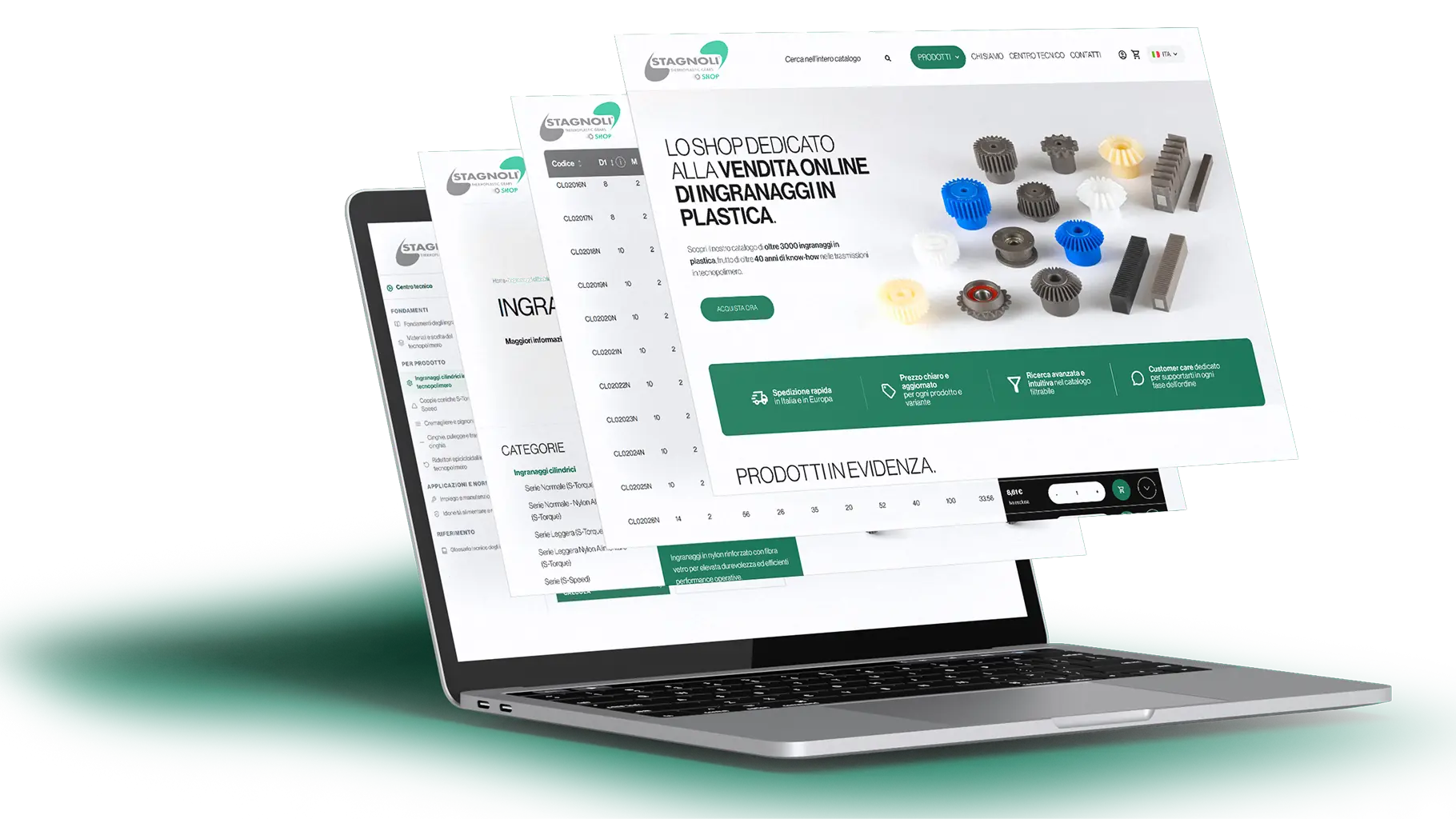
Standard Stagnoli bevel gear pairs are available on Stagnoli Gears Shop, with no minimum order. For advice on specific applications or custom solutions, contact our technical department: we will help you find the configuration best suited to your project.
NEXT NEWS
12 May 2018