Food-grade gears: why certifications and traceability make the difference
26 November 2026


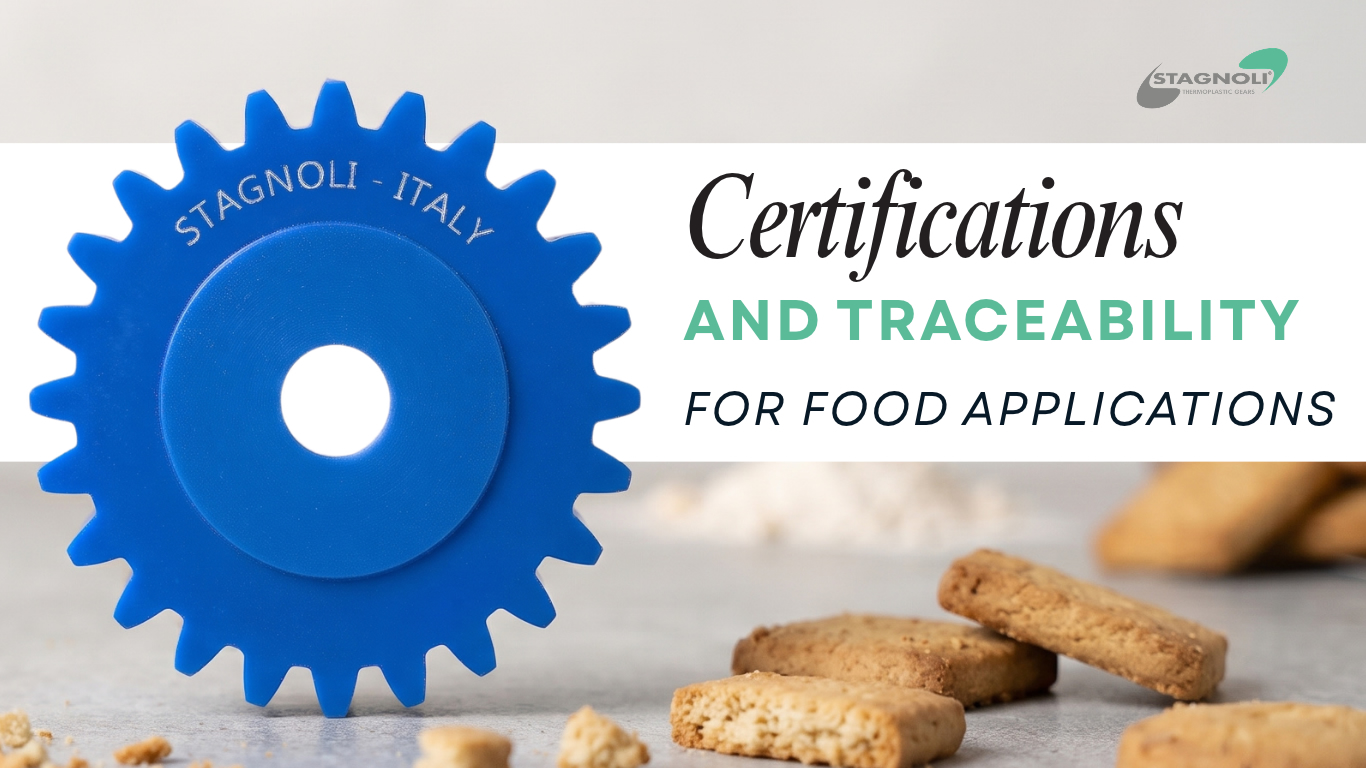
A quick guide to FDA certifications and EU Regulation 10/2011 for those who design and manufacture machinery for the food industry
In food industry machinery, gears are among the components most exposed to the risk of contamination. They operate right next to the product, undergo frequent washdowns with aggressive detergents, and often work in contact with fats, sugars, acids and moisture. A poorly chosen gear can release particles or chemical substances into the food, or degrade rapidly in harsh washdown environments.
For this reason, in the food sector a gear must not be assessed only on strength, precision and noise level. It must also be suitable for food contact, and its material must be traceable throughout the entire production chain.
Understanding the requirements commonly associated with MOCA and FDA certification for food-grade gears is therefore essential for machinery manufacturers looking to ensure regulatory compliance, operational reliability and food safety.
The regulatory framework in brief
Regulation (EC) 1935/2004. This is the European framework regulation on materials and articles intended to come into contact with food (FCM, known in Italy as MOCA). It establishes that no material may transfer constituents to food in quantities that could endanger human health, change the composition of the food, or worsen its organoleptic properties. It also requires traceability and a declaration of compliance for materials covered by a specific measure.
EU Regulation 10/2011. This is the specific measure for plastic materials and articles, including gears made of acetal (POM), polyamide (PA), PEEK and other engineering polymers. It contains the positive list of authorised substances, the overall and specific migration limits, and the rules on the declaration of compliance. It has been amended several times, including by Regulation (EU) 2025/351, published in February 2025, which also addresses recycled plastics and compliance documentation.
Regulation (EC) 2023/2006. It lays down good manufacturing practice (GMP) for FCM, and therefore the quality and control system that must be in place in production.
FDA (United States). For export to the US market, the reference is the Code of Federal Regulations, Title 21 (in particular Part 177 for polymers).
A point that is often misunderstood when sourcing FDA-certified gears is that the FDA does not normally issue certificates for individual materials. Instead, the manufacturer declares that the material complies with the applicable FDA requirements for its intended conditions of use.
Why traceability is decisive
When selecting MOCA-certified gears, machinery manufacturers should verify not only the compliance of the raw material but also the documentation supporting the finished component.
The compliance of a gear depends on that of the raw material, additives and colourants, but also on how the part is machined. To prove it, a continuous chain of documentation is needed:
Raw material: declaration of compliance from the polymer manufacturer (EU 10/2011 and/or FDA requirements), with the grade and specifications clearly stated.
Semi-finished product: rod, sheet or pellet identifiable by lot number.
Machining: machines, tools and cutting fluids that do not introduce unsuitable contaminants.
Finished product: gear linked to the lot of the original material, with documentation available to the customer.
If a single link in the chain is undocumented, overall compliance is at risk. In the event of a recall, inspection or audit (BRC, IFS, FSSC 22000), it is traceability that makes it possible to quickly find the origin of the problem and limit the intervention to the affected lots only.
Plastic and metal gears: what changes
When sourcing certified food-grade plastic gears, manufacturers must ensure that the components meet the requirements of EU Regulation 10/2011 for their intended food-contact applications.
Metal gears, such as those made of stainless steel, have no specific harmonised European measure: the framework Regulation 1935/2004, the Council of Europe guidelines and national rules apply. In Italy, for example, the Ministerial Decree of 21 March 1973 is relevant to stainless steels.
In both cases, suitable, documented and traceable materials are required.
Conclusion
Choosing gears suitable for food contact means protecting the consumer, but also the machine, the customer and the reputation of whoever builds it. Up-to-date compliance documentation, clear declarations of compliance and traceable materials are now a market requirement.
Whether the application requires MOCA-certified gears for the European market or FDA-compliant components for the US market, working with a supplier that can provide appropriate technical documentation is essential to ensuring compliance throughout the production chain.
Do you need gears for food applications? Contact our technical department to check materials, documentation and availability.
FAQ: Frequently asked questions
1. What does “suitable for food contact” mean?
It means that the material, under its intended conditions of use, does not release substances into food in quantities harmful to health, nor alter its composition, smell or taste. Suitability must be demonstrated with documentation and, where required, migration tests.
2. Are FDA-certified gears required for use in Europe?
No. In Europe, EU legislation applies (Regulation 1935/2004 and, for plastics, EU Regulation 10/2011). FDA compliance is relevant if the machine is intended for the US market or if the customer requests it. Many materials comply with both sets of rules, but this must be verified case by case.
3. Does the FDA issue a certificate for materials?
Normally not. The FDA does not generally issue individual material certificates. The manufacturer declares that the formulation complies with the applicable requirements of 21 CFR, and the customer can request supporting documentation.
4. What is a declaration of compliance (DoC)?
It is the document by which the supplier attests that the material meets the applicable rules. Among other things, it states the supplier’s identity, the material, the conditions of use, the permitted food types and any restrictions. It must be backed by technical documentation that the company must be able to present to the authorities.
5. What are migration limits?
They are the maximum quantities of substances that may pass from the material into the food. EU Regulation 10/2011 distinguishes between overall migration (the total of substances transferred) and specific migration (individual substances with their own limits).
6. Does a compliant material remain compliant if I machine it?
Not automatically. Machining, cutting fluids, lubricants or treatments can introduce contaminants. This is why Regulation 2023/2006 requires good manufacturing practice and a quality system throughout the entire process.
7. Why is traceability so important?
Because it links the finished part to the raw material lot and its declaration of compliance. In the event of a non-conformity or an audit, it allows the lots involved to be identified immediately and targeted action to be taken.
8. Are stainless steel gears covered by EU Regulation 10/2011?
No, that regulation covers plastic materials and articles. For metals, Regulation 1935/2004 and the applicable national rules and guidelines apply. Here too, suitable material and documentation are required.
9. Does the colour of the gear matter?
Yes. Colourants and additives must comply with the applicable authorisation requirements, restrictions and migration limits. This is why many certified food-grade plastic gears are supplied in specific colours, often white or blue, depending on the application and the need to detect fragments if they end up in the product.
10. Is a food-grade lubricant also needed?
If the gear requires lubrication and there is a risk of incidental contact with the product, suitable lubricants must be used, typically NSF H1 category. Many engineering-polymer gears run dry precisely to reduce this risk.
11. Do the rules change over time?
Yes. EU Regulation 10/2011 is updated periodically, including through Regulation (EU) 2025/351, with changes to authorised substances, restrictions and documentation rules. It is good practice to ask the supplier for up-to-date declarations of compliance.
NEXT NEWS
12 May 2018