Tribological comparison POM vs PA6: wear and friction coefficient
28 April 2026


Friction and dimensional instability: the pitfalls of dry transmissions
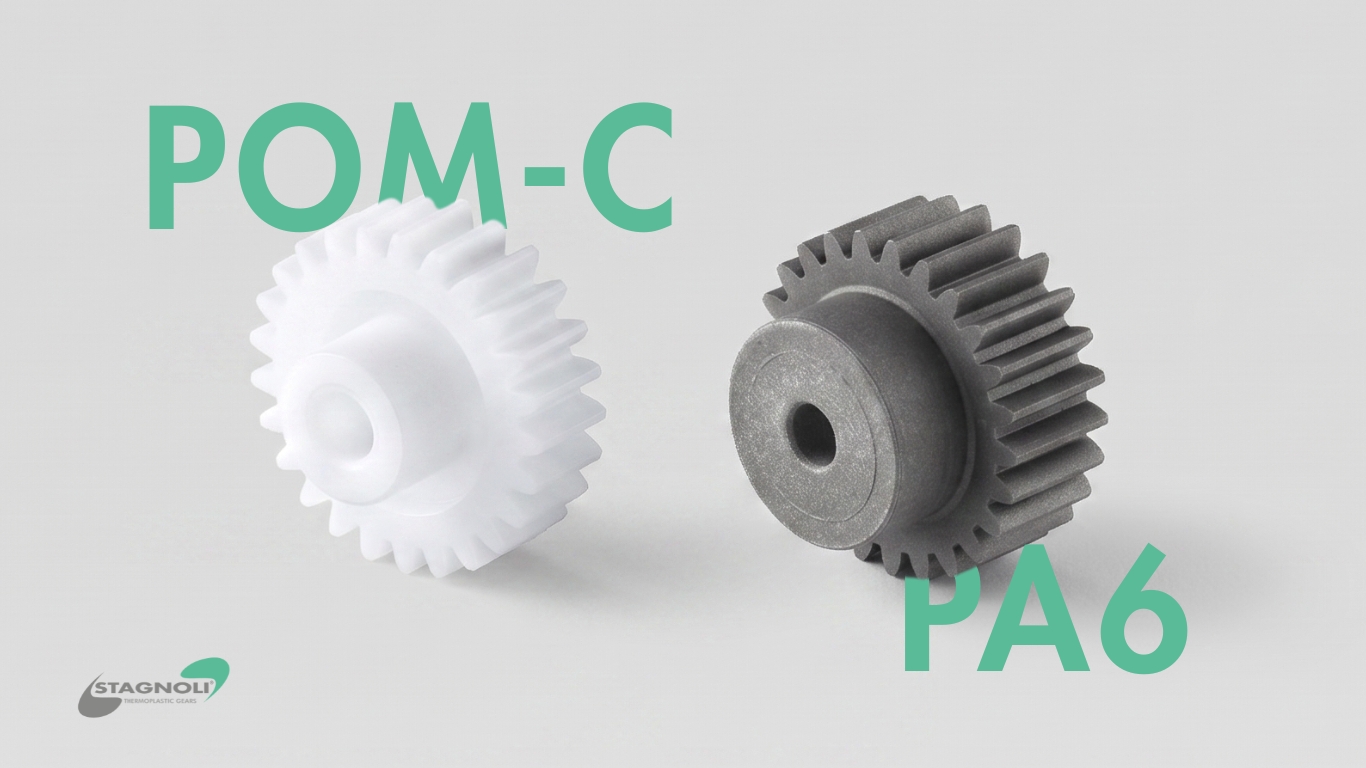
In the design of power transmission or linear motion systems operating without additional lubrication, the choice between POM-C (Polyoxymethylene) and PA6 (Polyamide 6) is never obvious. This is why a proper comparison POM vs PA6 becomes essential during the early design phase.
Often, the premature failure of a gear or bushing is not attributable to a module calculation error, but to an underestimation of tribological and environmental phenomena.
The critical problem lies in the management of heat generated by friction and in dimensional stability: a PA6 gear that absorbs moisture can vary its meshing backlash until it causes seizing, while a POM component subjected to unexpected shock loads can undergo brittle fracture due to its lower resilience compared to polyamides.
Understanding the real difference between POM and nylon PA6 is therefore crucial to correctly balance performance and durability.
Identifying the balance point between friction coefficient and mechanical strength is the main challenge to prevent unplanned machine downtime.
POM-C vs PA6: Analysis of tribological and mechanical parameters
The choice of plastic material for a dry transmission must be based on quantitative data derived from standardized tests (ISO 7148 or DIN 50324).
POM, thanks to its highly crystalline structure, offers an intrinsically low static and dynamic friction coefficient, reducing the 'stick-slip' effect.
Conversely, PA6 boasts superior mechanical properties at higher temperatures, but presents the unknown of hygroscopicity.
Below is the comparative data between the two materials in standard configuration:
Property | Unit | POM-C (Acetal) | PA6 (Nylon 6) |
Static friction coefficient (dry on steel) | μs | 0.25 | 0.38 |
Dynamic friction coefficient (dry on steel) | μk | 0.20 - 0.22 | 0.30 - 0.35 |
Moisture absorption (saturation in water) | % | 0.2 - 0.5 | 8.0 - 9.0 |
Dimensional variation (equilibrium at 23°C/50% RH) | % | < 0.2 | 2.5 |
Resilience (Notched Charpy @ 23°C) | kJ/m2 | 6 - 8 | 10 - 15 |
Continuous operating temperature | °C | 90 | 110 |
From the data analysis, it emerges that POM is technically preferable for dimensional precision and fluidity of movement, while PA6 is more suitable where the application involves heavy dynamic stresses, provided that the mounting tolerances are correctly calculated to compensate for hygroscopic expansion.
TCO reduction through tribological optimization
The operational impact of adopting the correct material—especially after a detailed POM vs PA6 evaluation—translates directly into a change in the Total Cost of Ownership (TCO).
Using POM in low-speed and constant-load applications reduces the starting torque required, often allowing the sizing of less powerful motors and reducing the plant's energy consumption.
Furthermore, the dimensional stability of POM (with variations of less than 0.2%) eliminates the need for post-installation calibration interventions, which are common with PA6 if not correctly stabilized.
However, in contexts where noise and vibrations are critical, PA6 acts as a natural damper due to its molecular structure, extending the useful life of bearings and shaft seats thanks to the reduction of transmitted dynamic stresses.
It is estimated that a correct polymer selection can extend preventive maintenance intervals by 40% compared to a generic choice, totally eliminating the costs associated with manual lubrication and related centralized distribution systems.
Beyond the thermal limit: when PA6 and POM become critica
Despite their excellent properties, both materials have a well-defined operating 'envelope'.
The main limit for these technopolymers is the interface temperature generated by the surface load and sliding speed (Pv).
POM-C: Above 100°C continuously, thermal stability decays and the material tends to release formaldehyde, compromising mechanical properties. In the presence of strong acids (pH < 4), POM undergoes rapid chemical degradation.
PA6: Although it can withstand higher thermal peaks than acetal resin, it suffers in environments with fluctuating humidity. An increase in relative humidity leads not only to swelling, but also to a drastic reduction in the elastic modulus (plasticization).
In the case of applications with Pv exceeding 0.15 MPa * m/s in the absence of lubrication, both POM and PA6 might not be sufficient.
In these grey areas, it is necessary to turn to high-performance materials or polymers filled with solid lubricants (PTFE or MoS2) to avoid the surface melting of the gear tooth or the sliding surface.
Frequently Asked Questions
- Is it possible to directly replace a steel gear with a POM-C or PA6 one?
No, not without a recalculation of the geometries. Technopolymers have much lower elastic moduli (about 1/50 compared to steel). It is necessary to verify the bending strength of the tooth according to the VDI 2736 standard (specific for thermoplastic gears) and, often, increase the module or the face width to compensate for the lower stiffness. - How does humidity affect the performance of a PA6 component?
Humidity acts as a natural plasticizer for PA6. It increases resilience (ability to absorb shocks), but drastically reduces surface hardness and tensile strength. The designer must consider that the mechanical properties reported in the 'dry' technical data sheets are not the real ones in 'conditioned' (wet) operation.
Glossary
POM (Polyoxymethylene): Crystalline polymer known as acetal resin, characterized by high stiffness and dimensional stability.
PA6 (Polyamide 6): Synthetic polymer (Nylon) with excellent mechanical and wear resistance properties, but sensitive to humidity.
Tribology: Science that studies friction, wear and lubrication of interacting surfaces in relative motion.
Hygroscopicity: Ability of a material to absorb water molecules from the surrounding environment, influencing its dimensions and properties.
Stick-slip: Jerky motion phenomenon caused by the difference between static and dynamic friction under poor lubrication conditions.
Contact our technical department for a feasibility assessment of your component.
NEXT NEWS
12 May 2018